How match scores work
The deterministic 0–100 score that shows how well an investor fits your round, the five weighted factors behind it, and a worked example.
Every investor OmniLead shows you in Raising mode has a match score from 0 to 100. The score is deterministic: the same investor and the same profile always produce the same number, and every point comes from a rule you can read below. There's no AI guessing and no hidden signal. Click any score to see exactly why it's that number.
The five factors
Each factor gets a score from 0 to 100. That score is multiplied by the factor's weight, and the five results are added up and rounded. A perfect fit on every factor scores 100.
How each factor is scored
Stage fit (30)
- 100: the investor backs your exact stage.
- 50: their nearest stage is one step away, for example they do Series A and you're raising a Seed.
- 0: they invest two or more stages away.
- 50 (neutral): the investor's stages aren't known, or your profile has no stage.
Sector fit (30)
- 100: they invest in your main sector (the first one in your profile).
- 85: they invest in one of your other sectors.
- 80: they describe themselves as generalist or sector-agnostic.
- 50: they invest in a related sector, for example fintech when you're in financial services.
- 0: no overlap.
- 50 (neutral): sectors unknown on either side.
Check size fit (20)
A useful check is anywhere between 5% of your round and the whole round. For a $2M raise, that's $100K to $2M.
- 100: the investor's check range overlaps that window.
- Up to 75: the range is outside the window. The further away, the lower the score: one order of magnitude off scores 50, two or more score 0.
- 50 (neutral): check size unknown, or no raise amount on your profile.
Geography (10)
- 100: they invest globally, in your country, or in your state.
- 90: they invest across a region that includes your country, such as EU, DACH, Nordics or APAC.
- 60: they invest in other states of your country, not yours.
- 0: they invest elsewhere.
- 50 (neutral): geographies unknown, or no country on your profile.
Recent activity (10)
Activity comes from the investor's most recent SEC Form D filing or known investment.
- 100: within the last 6 months.
- 70: within the last year, or dates unknown but deals in the last two years are on record.
- 40: one to two years ago.
- 10: more than two years ago.
- 30: no activity on record.
Worked example
You're raising a $2M Seed round for a company in California, with sectors Fintech (main) and Software. An investor in search has:
- Stages: Seed, Series A
- Sectors: Software, Security
- Check size: $250K to $1.5M
- Geographies: New York, Massachusetts
- Last Form D filing: 95 days ago
The investor scores 92, a Strong fit. If you moved Software to the top of your sectors, sector fit would rise to 100 and the score to 96.
What the labels mean
See the breakdown
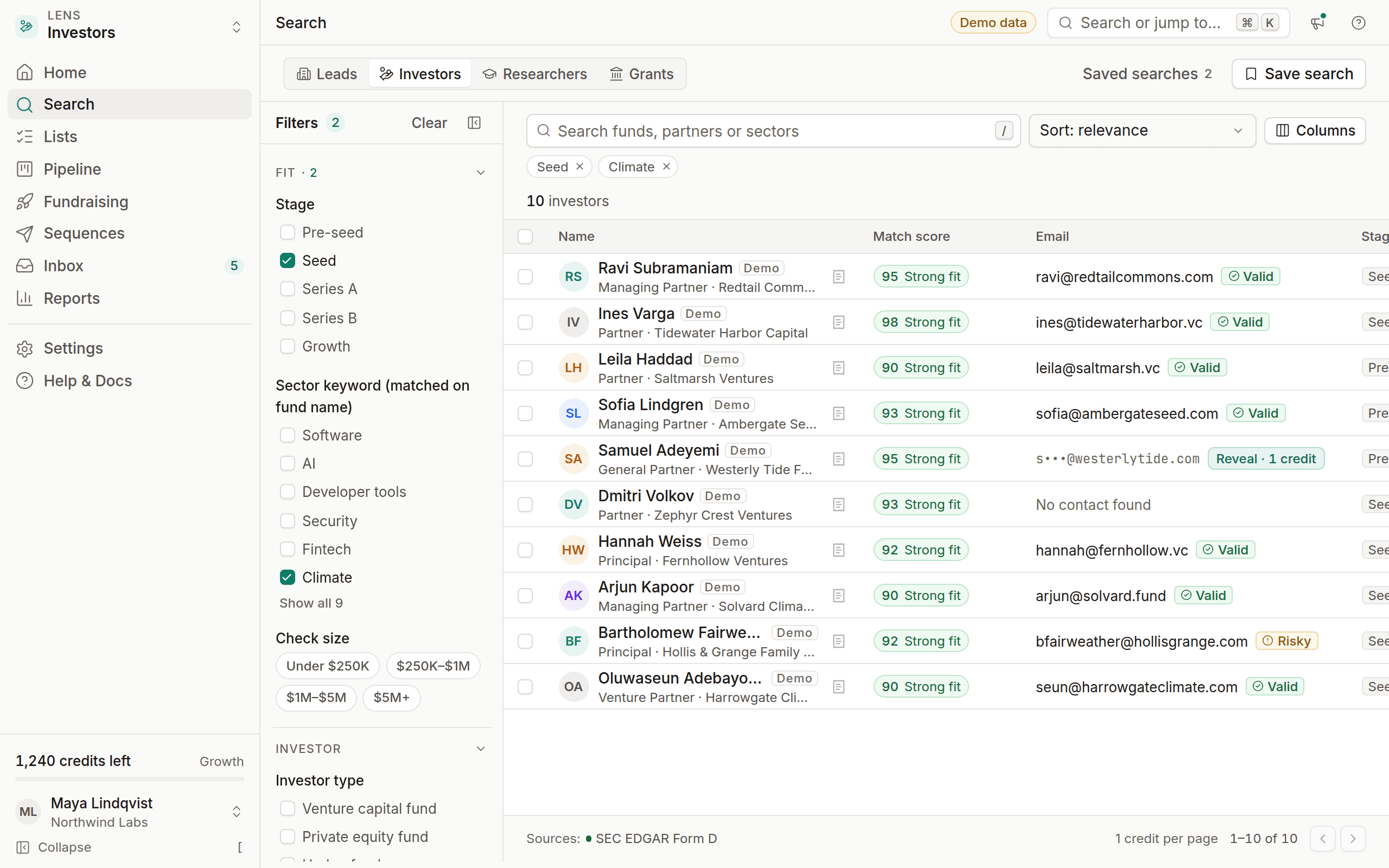
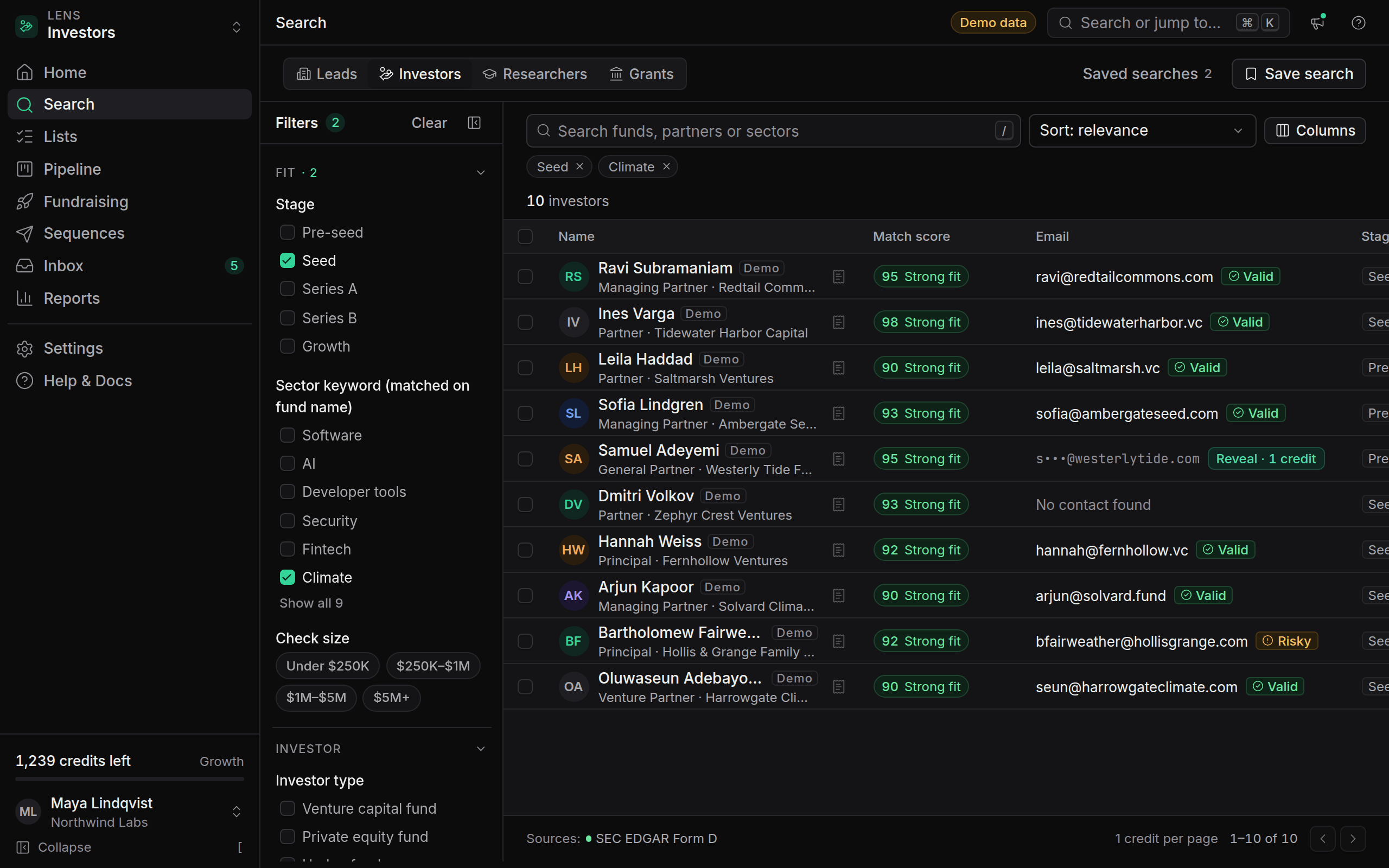
Search investors
Switch to the Investors lens and run a search.
Open a score
Click the match score on any result. A popover lists the five factors, each factor's points and the reason.
Sort by fit
Click the Match score column header to sort the results, best fit first.
Scores update when you edit your opportunity profile, and when new filings change an investor's recent activity. The same score appears on saved investors in your pipeline.
Why does a well-known investor score low?
Usually because their filings show a different stage or check size from your round. Check the breakdown: a big fund that writes $10M checks is a poor fit for a $1M pre-seed, however famous it is.
Can I change the weights?
No. Fixed weights keep scores comparable between searches and teammates. Use filters to narrow by the factor you care about most.
Does the score cost credits?
No. Scores are shown on search results, and search pages cost 1 credit each as usual. Opening a breakdown is free.